Packaging & Storage
Packaging, storage and dosage recommendations can be provided according to the specific product model and project requirements.

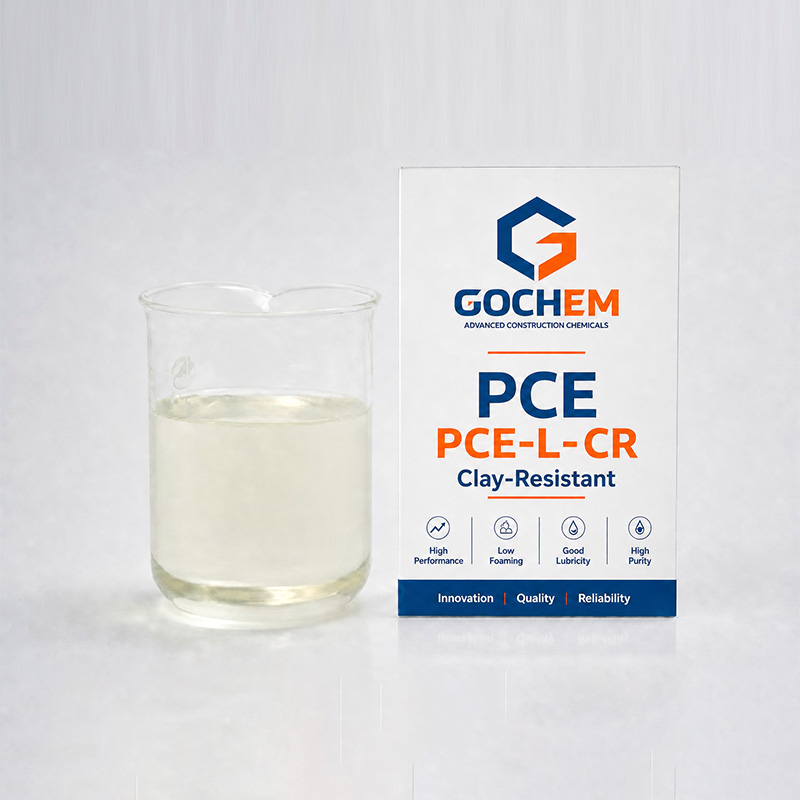
Stable formulation and reliable application performance for engineering use.
Designed to improve construction efficiency and material consistency.
Suitable for multiple concrete systems and project requirements.
Strict production and inspection process supports stable supply.
1. Product Introduction
Clay-tolerant polycarboxylate high-performance water-reducing admixture mother liquor (hereinafter “clay-tolerant mother liquor”) is an aqueous concentrated solution of a comb-type copolymer, obtained by free-radical aqueous solution copolymerization of macromonomers such as methylallyl alcohol polyoxyethylene ether with unsaturated carboxylic acids. The main chain carries anionic carboxylate adsorption groups, while PEO side chains form hydration layers; electrostatic repulsion and steric hindrance produce highly efficient dispersion of cement particles. Clay-tolerant grades are tailored in main-chain density, side-chain length/distribution and functional groups, often incorporating functional monomers or auxiliary chains with stronger competitive adsorption to layered silicates (montmorillonite, illite, etc.), reducing preferential adsorption and intercalation consumption of the main dispersant by clay.
This product is a “mother liquor” and is generally not dosed directly as a finished admixture. Instead, it is blended by admixture compounders or batching plants—together with slump-retaining, retarding/accelerating, air-entraining components and water—to a target solids content, based on cement, SCMs, aggregate clay content and placing requirements. Its value is not to “eliminate clay effects”, but to provide a wider effective dosage window and more robust initial flow and slump retention under fluctuating or high clay contents, thereby reducing production variability from washing, material changes or frequent mix adjustment.
2. Highlights and Advantages
|
Dispersion & retention |
Tunable PEO side-chain density balances initial dispersion and retention |
Reduces segregation/bleeding; improves pumping, long-haul and hot-weather placement |
|
Water reduction & strength |
High water reduction lowers w/b and supports later-age strength |
Saves cementitious materials or enables HPC; 28 d strength ratio meets HPWR requirements |
|
Compatibility & durability |
Low chloride, low alkali (by solids); compatible with common retarders/retainers |
Suitable for RC and PC where limits are verified |
|
Environment & handling |
Aqueous system, dispersible by mechanical mixing; controlled residual formaldehyde/ammonia |
Meets emission limits for indoor/underground use per GB 46039-2025 |
3. Main Technical Parameters
3.1 Homogeneity indexes of mother liquor (shipment/incoming control; example: 50 %±1 solids grade)
|
Item |
Unit |
Typical reference range |
Note |
Test basis |
|
Appearance |
— |
Light yellow to brownish-yellow, clear/slightly turbid liquid |
Visual; no obvious layering, sediment or lumps |
GB/T 8077-2023 cl.5 |
|
Solids content |
% |
50.0 ± 1.0 |
Dry to constant mass at 105 ℃±5 ℃; batch-to-batch control |
GB/T 8077-2023 cl.7 |
|
(20 ℃)Density |
g/cm³ |
1.10 ± 0.02 |
Pycnometer or precision hydrometer |
GB/T 8077-2023 cl.9 |
|
pH (as-received) |
— |
4.0 ~ 7.0 |
Glass electrode; (20±2) ℃, duplicate |
GB/T 8077-2023 cl.11 |
|
Cement paste fluidity |
mm |
≥240 at stated W/C & dosage |
State cement type, W/C, temperature, dosage (by solids); in-house comparison only |
GB/T 8077-2023 cl.15 |
|
Cl⁻ content |
% by solids |
≤ 0.10 |
Verify per GB 46039-2025 for reinforced/metallic-element concrete |
GB/T 8077-2023 cl.13 |
|
Total alkali |
% by solids |
≤2.0 (example limit) |
As agreed; flame photometry / AAS |
GB/T 8077-2023 cl.17 |
|
Insoluble matter |
% |
≤0.5 (recommended) |
Centrifuge/filter, dry and weigh; by agreement |
Agreement |
|
Viscosity |
mPa·s |
≤500 at 20 ℃ (example) |
Rotational viscometer; state temperature & spindle |
Agreement |
3.2 Recommended dosage and solids-normalized calculation (for process conversion, not a performance commitment)
|
Item |
Typical range |
Note |
|
Mother liquor dosage (by cementitious materials mass) |
0.20 % ~ 0.90 % |
Varies with solids, compounding ratio, cement and aggregate clay; determine by trial |
|
Active dosage by solids |
0.10 % ~ 0.45 % |
= mother liquor dosage × solids (based on 50.0 % for this grade); mid-to-high range common for clay conditions |
|
Recommended solids of compounded product |
25 % ~ 50 % |
Diluted with water/auxiliaries; balance dosing accuracy, transport and storage stability |
|
Conversion example |
— |
1.00 % mother liquor at 50.0 % solids → 0.50 % by solids |
3.3 Test-concrete performance (example: compounded product accepted as HPWR-S / HPWR-R; compare under identical clay conditions)
|
Item |
Unit |
HPWR requirement |
Typical attainable range |
|
Water reduction |
% |
≥ 25 |
26 ~ 32 |
|
Bleeding ratio |
% |
HPWR-S ≤ 60 |
20 ~ 55 |
|
Air content |
% |
≤ 4.5 |
2.0 ~ 4.5 |
|
Setting time difference |
min |
HPWR-S:-90 ~ +120 |
|
|
Slump 1 h change |
mm |
HPWR-S ≤ 80 |
20 ~ 70 |
|
(1 d / 3 d / 7 d / 28 d) |
% |
HPWR-A:≥180/170/145/130 |
|
|
(28 d)Shrinkage ratio (28 d) |
% |
≤ 110 |
95 ~ 108 |
* The “typical attainable range” is a synthesized reference compiled from public supplier sample data and the GB/T 8076-2025 HPWR limits; it is for trial-mix expectation only. Each grade, solids content and compounding scheme must be verified by type tests / shipment test reports under the actual mix design.
3.4 Hazardous-substance limits (verify when the finished product is used in reinforced or indoor/underground concrete)
|
Item |
Limit |
Application condition |
Test basis |
|
Cl⁻ |
|
Reinforced, metal-embedded or steel-fiber concrete/mortar |
GB 46039-2025 5.1 |
|
Released ammonia |
≤0.10 % by mass |
Indoor and underground spaces |
GB 46039-2025 5.1 |
|
Residual formaldehyde |
≤500 mg/kg by solids |
Indoor and underground spaces |
GB 46039-2025 5.1 |
4. Requirements for Use
|
Stage |
Requirement |
|
Compatibility verification |
Before first use, material/brand/batch changes or compounding changes, conduct paste fluidity and concrete trials (workability, setting, strength) to confirm no abnormal bleeding, flash set, delayed bleeding or slump rebound. |
|
Dosing & addition |
Dose as mass percent of cementitious materials; compound mother liquor to target solids first, then meter the finished product. Water-dilution, delayed or split addition are option-dependent; do not estimate visually. |
|
Dosage control |
Fix within the recommended range by trial; when clay rises,optimize aggregate and compounding (retention/clay-tolerant ratio) rather than increasing dosage without limit. |
|
Mixing & homogenization |
Use mechanical mixing for full dispersion; with delayed addition, ensure adequate mixing time to avoid localized overdosing or underdosing. |
|
Compounding & dilution |
Use water meeting concrete mixing-water requirements; confirm compatibility before adding auxiliaries. Track diluted product FIFO and periodically recheck solids, density and pH. |
|
Placement & curing |
Meet specified curing conditions; strengthen moisture curing in hot, windy or dry conditions. Admixture does not replace proper curing. |
5. Precautions
|
Item |
Requirement |
|
Material compatibility |
This anionic polycarboxylate system must not be mixed or stored together with naphthalene, amino-sulfonate or aliphatic superplasticizer mother liquors. Any co-use with retarders, AEAs, defoamers or VMAs requires compatibility and stability trials to avoid flocculation, separation or performance degradation. |
|
Clay is not infinitely compensable |
The product improves effective dispersant retention but cannot replace de-sliming, sand washing, gradation optimization or mix design. When MB value or clay/fines content exceeds project limits, treat the raw materials first. |
|
Setting & air monitoring |
Monitor initial/final setting and air content at high dosage, low temperature, with retarders or high clay. If excessive retardation, uncontrolled air or abnormal strength occurs, re-establish the mix and dosage. |
|
Freeze-thaw & temperature sensitivity |
Store and use the mother liquor generally at 5 ℃~40 ℃; avoid freezing and overheating. Frozen-then-thawed product may demulsify, separate or lose performance; do not use until confirmed by type testing. |
|
Safety & PPE |
The acidic-to-weakly-acidic liquor is irritating to skin and eyes. Wear chemical-resistant gloves, goggles and long-sleeve protective clothing; flush with copious water after contact and seek medical care if splashed in eyes or ingested. |
|
Cross-contamination |
Use dedicated tanks, pumps and metering lines; rinse and confirm no residue. Assess before blending mother liquors of different suppliers or batches. |
6. Packaging and Storage
|
Item |
Requirement |
|
Packaging |
Plastic drums (commonly 25 kg / 200 kg), IBC totes or tank-truck bulk; containers shall be clean, sealed and made of compatible material. |
|
Labeling |
State product name, grade/type, batch No., production date, net mass, solids, pH, storage conditions, applicable standard and ‘refer to SDS’. |
|
Storage temperature |
5 ℃~40 ℃; avoid freezing, high temperature and direct sunlight; prevent freezing in winter and drum/tank overheating in summer. |
|
Shelf life |
Under sealed original packaging and proper conditions, typical shelf life is 6~12 months; use opened containers promptly and reseal. Re-test if expired or if layering/odor/lumping appears before use. |
|
Homogenization |
Slight layering may occur after prolonged standing; stir uniformly before use. Do not use tools that may contaminate the product. |
|
Transport |
Handle gently to avoid leakage; do not transport with food, feed or strong oxidants; transport temperature per storage conditions. |
7. Scope of Application
|
Applicable object |
Description |
|
By project type |
Ready-mixed/cast-in-place ordinary concrete, pumped concrete, high-flow and self-compacting concrete, high-strength/high-performance concrete; railways, roads, bridges, tunnels, hydro/power, nuclear, ports, municipal and civil/industrial construction. |
|
By environment |
Conditions with fluctuating or elevated clay/fines content, unstable aggregate quality, hot-weather and long-haul placement, and where a longer slump-retention window is required. |
|
By function |
As the core mother liquor for compounding clay-tolerant HPWR/pumping agents, combined by tested ratio with retainers, retarders, AEAs, etc. |
|
Not applicable / require verification |
For severely off-spec clay, very poor gradation or organic/highly active clay, treat the aggregate first. For projects with defined setting, air, strength or durability (freeze-thaw, permeability, shrinkage) requirements, rely on project-specific trials and type tests. |
Packaging, storage and dosage recommendations can be provided according to the specific product model and project requirements.
We are ready to provide you with high-quality products and professional solutions.